
The way to say my love in spanish – The way to say “my love” in Spanish unlocks a world of romantic expression. Past the literal translation, understanding nuanced variations reveals the depth of affection within the Spanish language. This exploration delves into other ways to precise love, contemplating ranges of depth and essential cultural contexts. From informal to formal, this information empowers you to decide on the proper phrase, making certain your message resonates authentically.
Navigating the intricacies of romantic language in Spanish requires a deep understanding of cultural nuances. Completely different areas and generations have distinctive expressions for expressing affection. This information is not going to solely present an inventory of phrases however will even provide context, permitting you to decide on the proper phrases for any scenario, making certain your message is acquired with the specified intent and affect.
Completely different Methods to Specific Love in Spanish
Spanish, like every language, gives a wealthy tapestry of how to precise affection, from informal endearments to formal declarations. Understanding the nuances of those expressions is essential for efficient communication and demonstrating real connection. This exploration dives into the various vocabulary of affection in Spanish, analyzing the suitable contexts for every expression.Spanish gives a spectrum of how to precise love, various in formality and emotional depth.
Whereas “my love” in Spanish could be translated instantly as “mi amor,” understanding nuances like context and relationship dynamics is essential. This usually displays the emotional depth of the speaker. Take into consideration the implications of being excessive strung, as explored intimately here , and the way that may affect the selection of phrases when expressing affection.
In the end, deciding on the proper phrase for expressing “my love” hinges on the particular scenario and the specified emotional affect.
From on a regular basis phrases to extra profound declarations, the language permits for a variety of expressions, every with its particular context. This nuanced method allows audio system to tailor their language to the particular relationship and scenario.
Expressing affection in Spanish goes past easy translations; understanding cultural nuances is essential. Whereas “my love” could be conveyed in varied methods, realizing what “encanto” means in English what does encanto mean in english helps you tailor your expression to the particular context. In the end, one of the best ways to say “my love” in Spanish relies on the scenario and your relationship with the particular person you are addressing.
Formal Expressions of Affection
Understanding formal expressions is essential for navigating skilled and extra distant relationships. These expressions usually keep a respectful distance whereas nonetheless conveying affection.
- Te aprecio mucho: I recognize you very a lot.
- Tengo mucho cariño por ti: I’ve a number of affection for you.
- Te admiro: I love you.
These expressions, whereas much less overtly romantic, can nonetheless convey deep emotions of respect and care, appropriate for colleagues, members of the family, or pals in formal settings.
Casual Expressions of Affection
Casual expressions are utilized in shut relationships, reflecting a degree of intimacy and familiarity.
- Te quiero: I really like you (casual)
- Te amo: I really like you (casual)
- Te adoro: I am keen on you.
- Me gustas mucho: I such as you very a lot.
“Te quiero” is a standard and versatile expression, appropriate for a variety of relationships. “Te amo” is stronger, expressing deeper affection. “Te adoro” conveys intense adoration, whereas “me gustas mucho” exhibits a robust liking and affection. These casual expressions are essential for conveying emotions in on a regular basis conversations with family and friends.
A Comparative Desk of Expressions
| Expression | Which means | Context | Instance Sentence |
|---|---|---|---|
| Te quiero | I really like you (casual) | Shut relationships, pals, household | Te quiero mucho, eres mi mejor amigo. (I really like you very a lot, you are my greatest buddy.) |
| Te amo | I really like you (stronger) | Vital relationships, romantic companions | Te amo con todo mi corazón. (I really like you with all my coronary heart.) |
| Te aprecio mucho | I recognize you very a lot | Respectful relationships, colleagues, mentors | Te aprecio mucho por tu dedicación. (I recognize you very a lot on your dedication.) |
| Me gustas mucho | I such as you very a lot | Creating emotions, expressing curiosity | Me gustas mucho, quiero conocerte mejor. (I such as you very a lot, I wish to get to know you higher.) |
| Te adoro | I am keen on you | Intense affection, deep admiration | Te adoro, eres mi mundo. (I am keen on you, you might be my world.) |
This desk offers a structured comparability, illustrating the various contexts and intensities of those expressions. Understanding these nuances is essential to selecting the suitable expression for every scenario.
Whereas “my love” in Spanish has a number of translations, relying on the nuance you wish to convey, understanding the context is essential. This usually pertains to the deeper dialog about defining the connection, like discussing what a “DTR” dialog is, which clarifies expectations and limits. what is a dtr. In the end, one of the best ways to precise “my love” in Spanish relies on the particular scenario and your required degree of intimacy.
Ranges of Affection and Depth
Understanding the nuances of affection in Spanish is essential for genuine communication. Past the straightforward “I really like you,” Spanish gives a wealthy tapestry of phrases expressing completely different ranges of depth and intimacy. This exploration delves into the subtleties of expressing love, permitting for extra nuanced and acceptable communication in varied contexts.
Whereas “my love” in Spanish could be expressed in varied methods, relying on the context, exploring the nuances of phrases like “mi amor” and “mi cariño” is essential. Understanding the right way to convey affection successfully is essential, however it is equally essential to understand the that means of phrases like “dwu” in textual content, as seen in dwu meaning in text.
This may assist refine your communication and guarantee your message is acquired precisely, finally making your expressions of affection in Spanish extra impactful.
Various Levels of Affection
Spanish, like English, encompasses a spectrum of how to precise love, from informal affection to profound declarations. The selection of phrases displays the depth of the connection and the particular context. Recognizing these variations enhances your potential to convey the supposed message successfully.
Gentle Affection
Expressing delicate affection in Spanish usually makes use of phrases which are extra informal and on a regular basis. These phrases are appropriate for shut pals, members of the family, or colleagues.
- Te quiero (I such as you): A typical expression that conveys fondness and affection, appropriate for expressing care and heat in on a regular basis interactions. It is much like the English “I such as you,” however with a barely hotter connotation.
- Me gustas (You please me): This phrase implies a level of liking and appreciation, highlighting constructive emotions and delight of somebody’s firm.
- Estoy feliz de estar contigo (I am joyful to be with you): This phrase is right for conveying happiness and pleasure in somebody’s presence.
Reasonable Affection
For expressing reasonable affection, Spanish gives a spread of phrases that transcend informal fondness and trace at deeper emotions. These are appropriate for romantic companions, shut members of the family, or vital others.
- Te aprecio mucho (I recognize you numerous): This phrase emphasizes respect and worth, highlighting the constructive qualities of the particular person.
- Te admiro (I love you): This phrase suggests respect and admiration for the opposite particular person’s qualities, exhibiting a deep appreciation.
- Eres muy importante para mí (You’re crucial to me): This assertion underscores the importance of the particular person in your life.
Robust Affection
When expressing robust affection, the language turns into extra passionate and intense. These phrases are usually reserved for romantic companions or shut members of the family.
- Te amo (I really like you): The commonest and extensively understood expression of robust love. This phrase instantly conveys deep affection and romantic attachment.
- Te adoro (I am keen on you): This phrase expresses a deeper, extra intense degree of affection, usually utilized in romantic contexts to convey profound adoration.
- Mi vida (My life): This phrase, when used with affection, implies that the particular person is an integral a part of your life and existence.
Comparability Desk: Ranges of Affection
| Depth Stage | Phrase | Instance Sentence |
|---|---|---|
| Gentle | Te quiero | Te quiero mucho, eres una gran amiga. (I like you numerous, you are an excellent buddy.) |
| Gentle | Me gustas | Me gustas mucho, eres muy divertido. (I like you numerous, you are very humorous.) |
| Reasonable | Te aprecio mucho | Te aprecio mucho por tu apoyo incondicional. (I recognize you numerous on your unconditional help.) |
| Robust | Te amo | Te amo con todo mi corazón. (I really like you with all my coronary heart.) |
| Robust | Te adoro | Te adoro más que a nada en el mundo. (I am keen on you greater than something on the planet.) |
Cultural Concerns and Contextual Utilization
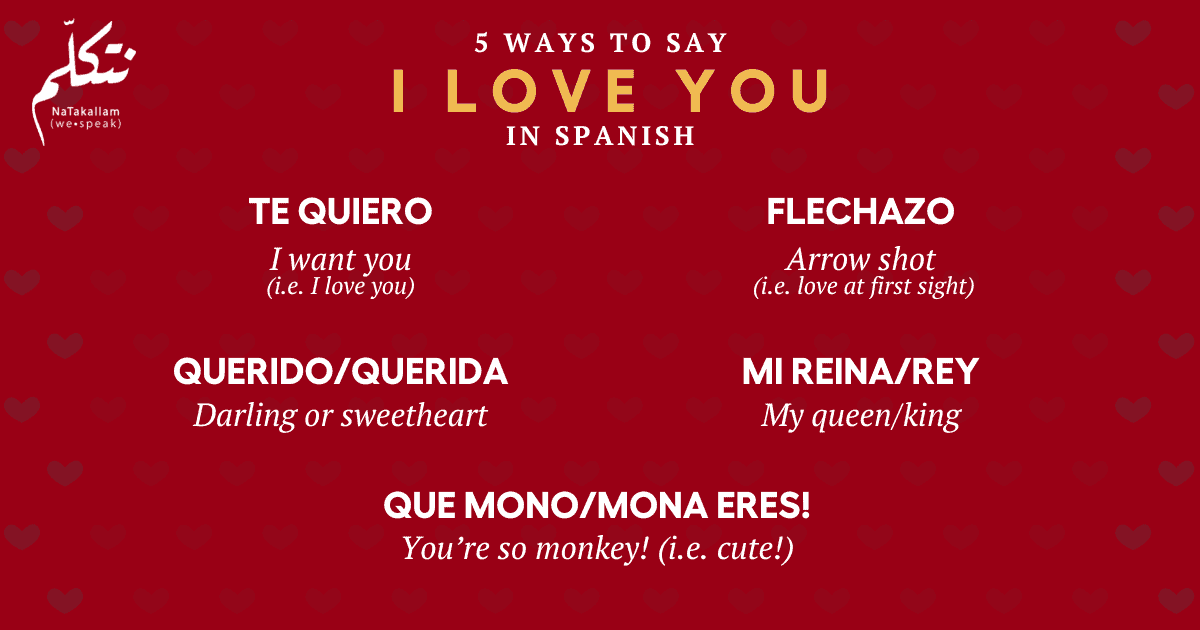
Understanding the nuances of expressing love in Spanish-speaking cultures is essential for efficient communication. Past the phrases themselves, tone, physique language, and the particular social context play a major position in conveying affection. This exploration delves into the cultural variations in expressing love, highlighting how these variations have an effect on the that means and affect of declarations of affection.Expressing love in Spanish is a posh tapestry woven from cultural threads.
The precise phrases chosen, the way by which they’re delivered, and the general social context are very important components. Variations exist between generations, social lessons, and even geographical areas inside Spanish-speaking nations. This understanding goes past merely realizing the phrases; it is about greedy the cultural context to keep away from misunderstandings and foster significant connections.
Regional Variations in Expressions
Completely different Spanish-speaking nations have distinctive customs and traditions relating to love and affection. Formal expressions may be extra frequent in some areas than in others. These variations are deeply rooted in historical past, custom, and social norms. Understanding these variations can result in extra genuine and efficient communication.
- In some Latin American nations, public shows of affection are extra frequent than in others. In sure areas, holding arms or kissing in public is commonplace and seen as an indication of affection and closeness. Nevertheless, in different nations, such shows may be much less frequent or perceived as overly demonstrative.
- Formality in language can range considerably. Older generations would possibly want extra formal expressions of affection, whereas youthful generations would possibly lean in direction of extra informal and casual language.
- Regional dialects and slang play a job in how love is expressed. Sure expressions may be understood solely inside particular areas or social circles.
Social Context and Appropriateness
The appropriateness of an expression of affection relies upon closely on the social context. Public shows of affection may be completely acceptable at a household gathering however inappropriate in an expert setting. Understanding the social norms inside the specific context is crucial for efficient communication.
Studying the right way to say “my love” in Spanish is a good way to attach with Spanish audio system. Whereas exploring varied phrases, you would possibly come upon on-line developments just like the that means of “womp womp” on TikTok, a sound usually used to precise disappointment. Understanding this TikTok slang might help you higher navigate social media, however finally, mastering phrases like “mi amor” or “mi cariño” will serve you properly in expressing affection in Spanish.
- Formal settings, corresponding to enterprise conferences or job interviews, necessitate a extra reserved method. Casual expressions may be perceived negatively.
- Intimate settings, corresponding to with shut pals or members of the family, extra open and affectionate expressions are acceptable.
- Public settings range. Some cultures encourage public shows of affection, whereas others are extra reserved. Understanding the native customs is essential to keep away from misunderstandings.
Generational Variations
Generational variations considerably affect how love is expressed in Spanish-speaking cultures. Older generations could adhere to extra conventional expressions of affection, whereas youthful generations would possibly embrace extra trendy and informal methods of expressing love.
- Older generations could favor extra formal expressions of affection, emphasizing respect and custom. Phrases like “querido” (beloved) or “amado” (cherished) may be extra frequent.
- Youthful generations would possibly use extra casual and informal language, counting on slang or extra trendy phrases.
- This distinction is mirrored in the way in which affection is expressed, with older generations usually favoring extra reserved shows in comparison with youthful generations, who could also be extra snug with open shows of affection.
Tone and Physique Language
The tone of voice and physique language considerably affect the that means of expressions of affection in Spanish-speaking cultures. A mild contact, a heat smile, or a comfortable tone can add depth and nuance to spoken phrases.
- A comfortable tone of voice can convey tenderness and intimacy. A loud or overly boisterous tone could be interpreted as inappropriate or disrespectful.
- Physique language, together with gestures and bodily contact, performs a important position in conveying affection. A heat embrace or a mild contact can specific deep affection.
- Cultural norms dictate the appropriate degree of bodily contact. Overly demonstrative gestures in some cultures could also be seen as inappropriate.
Cultural Context Examples, The way to say my love in spanish
| Nation/Area | Context | Expression | Be aware |
|---|---|---|---|
| Mexico | Household gathering | “Te quiero mucho” (I really like you very a lot) | Frequent and acceptable expression |
| Spain | Romantic date | “Te adoro” (I am keen on you) | Extra formal, romantic expression |
| Argentina | Shut pals | “Sos un amor” (You are a sweetheart) | Casual and affectionate expression |
| Colombia | Public show | Holding arms | Frequent and acceptable in lots of social settings |
Last Abstract

Expressing love in Spanish is a wealthy tapestry woven with cultural nuances and ranging ranges of depth. By understanding the other ways to say “my love,” you may be outfitted to speak your affection with precision and authenticity. Bear in mind, choosing the proper expression relies on the context, the connection, and the specified degree of intimacy. This exploration gives a priceless framework to navigate the nuances of expressing love within the Spanish language.
FAQ Defined: How To Say My Love In Spanish
What are some casual methods to say “my love” in Spanish?
Casual phrases like “mi amor,” “mi vida,” and “mi cariño” convey affection and endearment. The selection relies on the familiarity with the particular person you are addressing.
How does the tone of voice affect the that means of expressions of affection in Spanish?
Tone performs an important position in conveying the supposed that means. A mild, loving tone can rework a easy phrase right into a heartfelt expression of affection, whereas a harsh tone can simply misread the supposed message.
Are there regional variations in how affection is expressed in Spanish-speaking nations?
Sure, regional variations exist. Whereas “mi amor” is frequent, different phrases may be extra prevalent in particular nations or areas. Cultural norms affect the appropriateness of sure expressions.
How can I present my love in Spanish if I’m not fluent?
Even fundamental phrases like “Te amo” (I really like you) and “Te quiero” (I really like you) can convey affection. Utilizing these easy expressions, mixed with physique language and context, demonstrates your emotions even when you do not have a deep data of the language.
